
Tulsa and Oklahoma City hit pause on new data centers this year. The ones already approved are still getting built, and they're hiring from the same pool of electricians your next school, clinic, or church needs.
Data centers have been one of Oklahoma's biggest local stories in 2026. Tulsa paused new ones in March. Oklahoma City followed in April, and several other cities have talked about doing the same. On October 27, the OKC City Council still approved zoning for two large data center sites on the city's far west side, because those applications came in before the pause. Mayor David Holt has asked to extend Oklahoma City's moratorium another six months, and Tulsa's planning office owes its council zoning recommendations this month, ahead of a December 31 expiration.
Most of that debate is about water, power bills, and noise. Those are fair questions for city councils to work through, and this post isn't going to weigh in on whether Oklahoma should want more data centers.
This post is about something that gets a lot less airtime: the people and the equipment it takes to build them. If you're planning a building in the next two years, you're shopping in the same market.
Key Takeaways
A moratorium pauses new approvals. It doesn't stop the projects already approved or under construction.
Electrical work makes up roughly half the labor on a data center, and electricians are already the hardest craft to hire.
Data centers also compete for the same switchgear, transformers, and generators your building needs.
Owners who bring their builder and electrical contractor in early will have the most room to plan around it.
What's Already Being Built in Oklahoma
The pause slows down the next wave. The current one is already moving.
In east Tulsa, Meta broke ground on its $1 billion Project Anthem campus on April 21 and expects more than 1,000 construction workers on site at peak. Its first two phases are exempt from Tulsa's moratorium.
In Stillwater and Pryor, Google's $9 billion Oklahoma investment, announced in August 2025, covers a new Stillwater campus and an expansion in Pryor, with both expected to finish between 2027 and 2028.
In Mayes County, Lambda announced on September 27 that it plans a new data center at MidAmerica Industrial Park near Chouteau. A construction start hasn't been announced yet.
In west Oklahoma City, the two sites rezoned on October 27 still need more agreements before they can break ground, but they're in the pipeline.
None of those projects are held up by the pauses. They'll be hiring electricians, pipefitters, and HVAC technicians through 2027 and into 2028. That's the same window a lot of Oklahoma owners are planning to build in.
Electricians Were Already Hard to Find
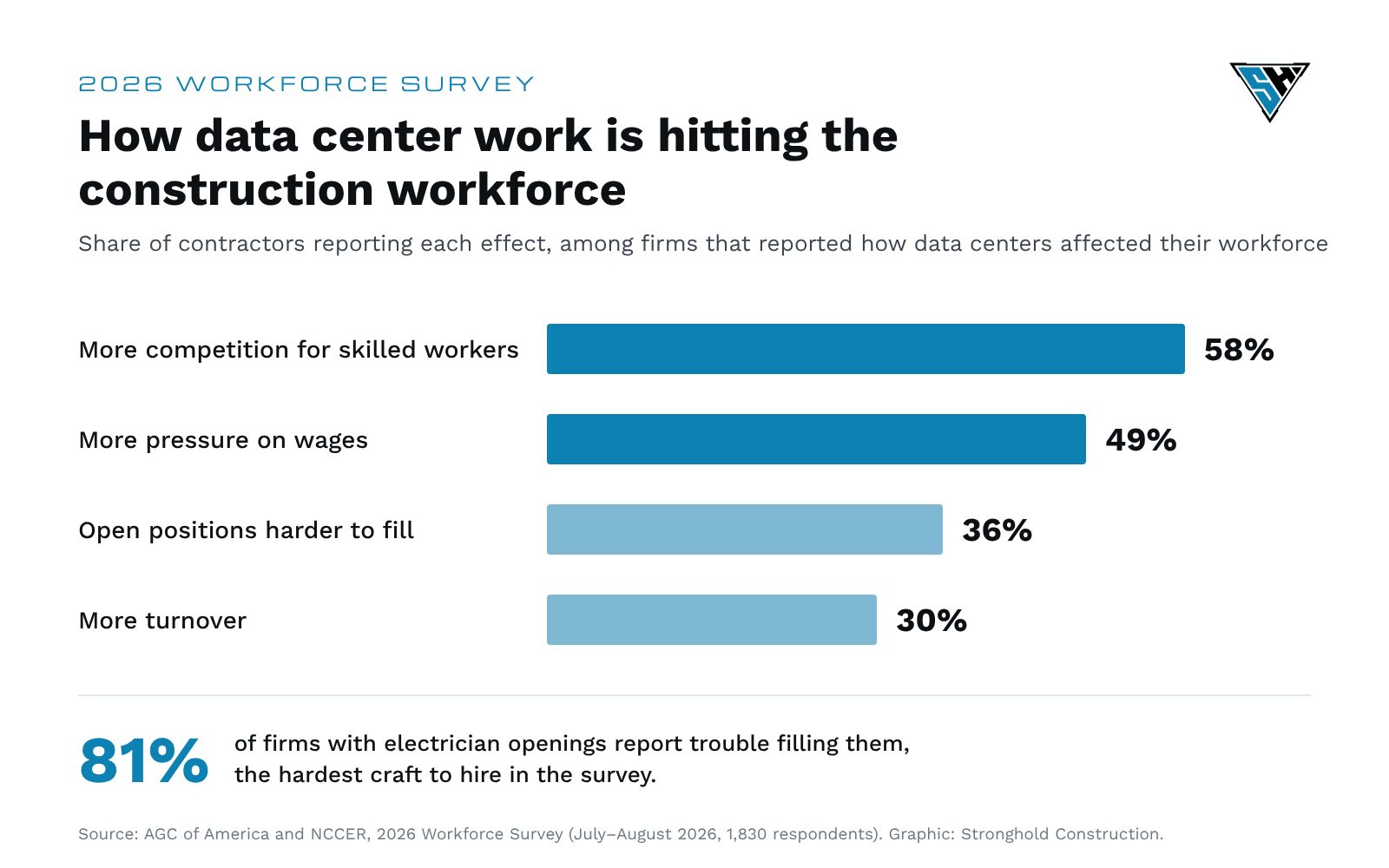
The Associated General Contractors of America and NCCER surveyed construction firms this summer for their 2026 Workforce Survey, with 1,830 respondents. Electricians came out as the hardest craft to hire. 81% of firms with electrician openings said they're having trouble filling them.
Data centers are adding to that. 28% of the firms surveyed had done data center work in the past year. Among firms that reported how data centers affected their workforce, 58% said it increased competition for skilled workers and 49% said it put more pressure on wages.
Electrical is the trade that matters most here. The CEO of Associated Builders and Contractors told Bloomberg this summer that electrical work accounts for about half of all labor on a data center project.
I grew up in an electrical contracting family, so I'll say this plainly. You can't hire your way out of an electrician shortage in a few months. It takes years to turn an apprentice into a journeyman. When the biggest jobs in the state need hundreds of electricians at a time, everyone else feels it in crew sizes, in pricing, and in how many electrical contractors bid your project.
The schedule feels it too. In the same AGC survey, 42% of contractors said worker shortages have delayed their projects, more than any other cause.
The Equipment Is the Other Bottleneck
Labor is half of it. Equipment is the other half.
Switchgear, transformers, and generators come out of the same factories whether they're headed to a data center or a middle school. In the AGC survey, 29% of contractors said long lead times or shortages on electrical equipment have delayed projects. Industry surveys put average switchgear lead times around 44 weeks as of mid-2025, and the largest equipment takes much longer.
That's most of a year before the gear that powers your building shows up. If nobody orders it until the drawings are finished and the job is bid, your opening date is at risk before anyone breaks ground.
What This Means for Your Project
None of this means you should put your project on hold. It does mean the usual order of operations costs more than it used to. Here's what we'd tell any owner planning to build in Oklahoma over the next two years.
1. Bring your electrical contractor in during design
Pick your electrical and mechanical trades early, the same way you'd pick your architect, and bring them to the design table. A contractor who's committed to your job before the drawings are done is planning a crew around it. A contractor you're hoping will bid your job eight months from now may not have one.
2. Order long-lead equipment as soon as the design allows
Identify your switchgear, generators, transformers, and major mechanical units during early design, get them approved, and get them ordered. An early equipment package can take months of risk out of your schedule.
3. Price labor where the market is headed
If your budget is built on last year's electrical labor rates, it's already behind. Ask your builder what they're carrying for labor escalation and why. Then keep pricing the design as it's drawn, so nobody is surprised when the numbers come back.
4. Build the schedule around the equipment
Start your schedule from the date the equipment can actually show up. We'd rather tell you that date on day one than surprise you with it in month nine.
If your project is public and has to go out to hard bid, plan for this market. Watch your bid date, expect fewer electrical bidders, and get your engineer working on equipment specs early. If you have a choice in how you deliver your project, this is the kind of market where early builder involvement earns its keep.
Plan Around It Now
Data centers will keep coming to Oklahoma in some form, and city councils will keep working out where they belong. Your project doesn't have to wait on that debate. The owners who come out ahead over the next two years will be the ones who line up their trades and their equipment before the rest of the market goes shopping.
Construction is already hard. We don't need to make it any harder.
Planning a project in Oklahoma? Let's talk before the design is locked. Talk to Our Team
We Dare to Build Better.
Sources: AGC of America and NCCER, 2026 Workforce Survey (Sept. 2026); Meta newsroom (Apr. 2026); HPPR / KOSU and FOX23 on Google's Oklahoma investment (Aug. 2025); Lambda (Sept. 27, 2026); City of Oklahoma City (Apr. 21, 2026); Tulsa Flyer (Aug. 24, 2026); KOKH FOX 25 (Oct. 27, 2026); Bloomberg via Insurance Journal (July 8, 2026); POWER Magazine (2026).