
Should I Call an Architect or a GC First? Why Most Commercial Owners Have the Sequence Backwards
It's the question almost no one asks until they're already in trouble. And the answer — backed by decades of industry research — will cost you more to ignore than almost any other decision you'll make on your project.
Stronghold Construction Oklahoma City, OK - CM at Risk · Design-Build · Preconstruction
Walk into any commercial project kickoff meeting in Oklahoma — new facility, tribal community center, medical clinic, corporate build-out — and ask the owner how they got started. Nine times out of ten, the answer is the same. They hired an architect, got drawings done, and then went out to bid.
It sounds like the right order of operations. It feels responsible — design first, then build. But it's the single most common structural mistake in commercial construction, and it quietly drives a disproportionate share of cost overruns, schedule delays, and scope compromises that owners spend years recovering from.
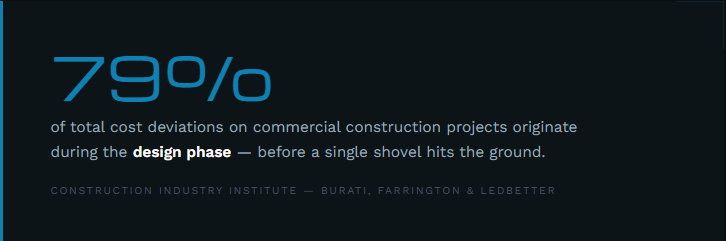
The issue isn't architects.
The issue is asking one profession to carry a responsibility that belongs to another — and then wondering why the bids don't match the budget.
What Architects Are — And Aren't — Built to Do
This is not a knock on architects. A good architect is essential to any significant commercial project. They translate your operational needs into a building. They navigate code, life safety, accessibility, and the hundred spatial decisions that determine whether a building actually works for the people inside it. None of that changes.
What architects are not trained to do is price construction.
The AIA has acknowledged this directly: "Detailed construction cost estimating is a skill generally outside the realm of architects' professional expertise. Estimating requires detailed knowledge of construction materials, methods, sequence, and labor. Contractors acquire this knowledge through direct construction and cost management experience and daily interaction with material suppliers, manufacturers, subcontractors, and workers."
So when a design team moves through schematic design, design development, and construction documents without a general contractor in the room, they're making hundreds of decisions — structural system, mechanical approach, building envelope, finish specifications — without real-time pricing on any of them. The architect's cost estimate is, at best, an educated guess. At worst, it's a number the owner plans a project around that has no grounding in what the market will actually price.
When bids come back — and they almost always come back high — the owner has limited options. You go back to the architect. You cut finishes. You value-engineer the mechanical system. You delete the features you actually wanted. You call it optimization. What you actually did was pay your architect to design a building you couldn't afford, then pay them again to redesign it into something you didn't plan for.
"All too often, the contractor builds from a complete set of drawings without having been able to influence what has been designed."
— Business Roundtable, 1982. The industry is still having this conversation.
The Cost of Fixing Problems at the Wrong Stage
The Construction Industry Institute has documented what they call the cost-of-change multiplier. A problem caught and corrected during schematic design costs roughly $1 to fix. The same problem caught during the construction documents phase costs $10. Caught during construction itself — after trades are mobilized, materials are ordered, and the building is going up — the cost is $100.
That's not theoretical. That's the loaded cost of rework: the redesign fees, the subcontractor time, the schedule ripple, the delay to dependent trades. Direct rework alone averages 5% of total construction cost on commercial projects. On a $10 million job, that's $500,000 in waste — most of it traceable to decisions made (or not made) during design.
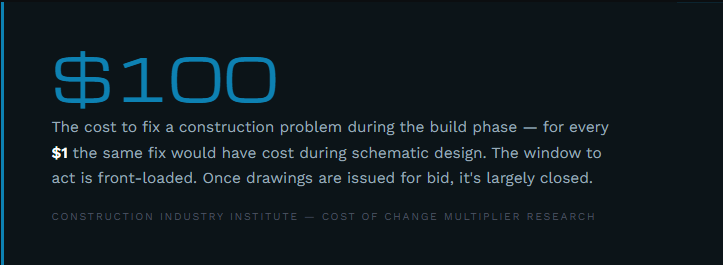
This is why CII's constructability research found that 73% of all constructability savings are achieved by the time only 20% of engineering is complete. The window to make good, cost-informed decisions is front-loaded. It closes fast.
Under the traditional design-bid-build model, the person with the most knowledge about what things actually cost isn't in the room while that window is open.
What "Value Engineering" Usually Actually Is
Value engineering gets talked about in the industry like it's a precision instrument. A systematic review of a design to find smarter, more cost-effective ways to deliver the same function. And in the right context — during design, with the contractor and design team collaborating from day one — it can be exactly that.
But most owners don't experience that version. What most owners experience is this: bids come in over budget, a meeting is called, and a list of cuts gets handed to the architect. Drop the canopy. Swap the flooring. Specify a different roofing system. Reduce the glazing. These aren't value engineering decisions — they're scope compressions that happen because no one was managing cost during design. The GC wasn't there to say, six months ago, "this structural approach is going to price out 20% higher than the alternative and you won't see the difference from the outside."
Real value engineering happens during preconstruction. It happens when the contractor is at the table during schematic design, pricing systems in real time, flagging constructability issues before they become details in a set of CDs, and helping the design team make informed decisions about where to spend the budget and where not to. That collaboration requires one thing: the GC being engaged before design is complete — ideally before it starts.
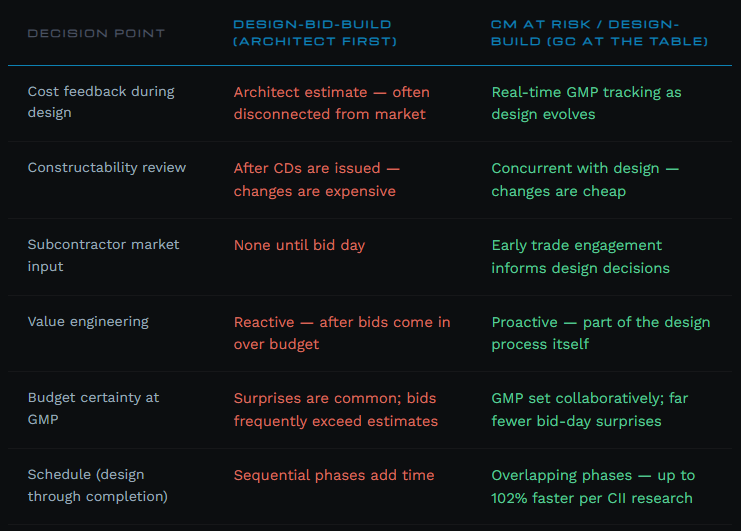
Decision Point Matrix
The Delivery Method Is the Answer
CM at Risk and Design-Build don't just add a GC to your project earlier — they change the contractual structure to make that early involvement the foundation of how the project is managed. In CM at Risk, you hire the architect and the GC separately, with the GC engaged during design to provide preconstruction services, develop a Guaranteed Maximum Price, and manage trade contractor procurement. In Design-Build, the GC and architect operate as a single entity under one contract with the owner — the most integrated structure available.
Both approaches move the contractor into the design conversation before design decisions are locked. Both produce buildings where cost and constructability have been considered in real time. And both have a substantial track record against the traditional model — across thousands of comparable projects.
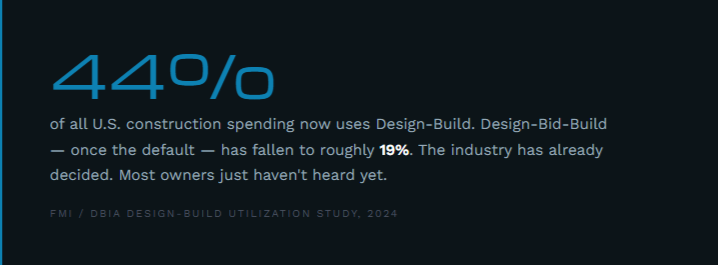
A 2018 study by the Construction Industry Institute and Pankow Foundation analyzed 212 commercial projects and found that Design-Build delivered 3.8% less cost growth and completed 102% faster from design through completion compared to Design-Bid-Build. CM at Risk showed 1.4% less cost growth and 25% faster delivery.
These aren't rounding errors on a $10 million project. They're real dollars and real months.
When Architect-First Actually Makes Sense
Not every project fits the same model — and this would be a dishonest post if it didn't acknowledge that.
There are projects where design-bid-build is the appropriate delivery method. Public projects bound by Oklahoma's competitive bidding statute are often legally required to use it, though CM at Risk and Design-Build have statutory paths as well. Projects where the architectural vision is the primary driver — highly custom civic buildings, complex historic renovations — sometimes warrant architect-first engagement. Projects with extremely straightforward scopes and no budget sensitivity may not need the overhead of a preconstruction engagement.
But those are the exceptions. For the majority of commercial owners evaluating a $5M–$50M facility — a healthcare clinic, a tribal community center, a corporate headquarters, a K-12 building, a childcare facility — the calculus almost always favors early GC engagement. The budget constraints are real. The schedules are tight. The subcontractor market doesn't wait for perfect drawings. And the cost of getting the sequence wrong is not theoretical. It shows up in every value engineering meeting, every change order, every project that delivers 15% over the number the owner started with.
The Right Question to Ask Your GC
Before your next project, ask any general contractor you're considering: "What does your preconstruction process look like, and when do you want to be engaged relative to design?"
The answer tells you almost everything. A GC who says "just send us the drawings when they're ready" is wired for the old model. A GC who walks you through their preconstruction phase — budgeting milestones, constructability review process, trade partner engagement, GMP development — is built for something different.
The sequence starts with that conversation. And that conversation should happen before you've committed to a design.
The Sequence Is a Decision
Here's the core of it: the order in which you hire your design and construction team is not administrative. It's one of the most consequential project decisions you'll make. It determines whether cost feedback is built into your design or bolted on after the fact. It determines whether your GC can catch problems when they're cheap to fix or only after they're expensive. It determines whether your value engineering is a design tool or a damage control exercise.
The traditional sequence — architect first, bids second — has the logic of convention behind it. It's how it's always been done. But it concentrates cost risk in exactly the wrong place, and the industry's own research has been documenting that for more than thirty years.
The first call doesn't have to be to a GC. But the GC needs to be in the room before design decisions are made — not after they're committed to paper. That's not a preference. That's the difference between a project that hits budget and one that doesn't.
Start the Conversation Before Design Starts
Stronghold Construction is a veteran-owned commercial GC and construction management firm based in Oklahoma City, specializing in CM at Risk, Design-Build, and Progressive Design-Build for tribal nations, healthcare, and private-sector clients across Oklahoma. Our preconstruction process is built to engage early — and to give owners real cost certainty before design locks in scope they can't afford.
If you have a project in planning, the best time to call us is before your architect starts schematic design. The second best time is right now.
We Build in a Way the Industry Can't.

Stronghold Construction, LLC · Oklahoma City, OK · Veteran-Owned