
Voters approve the list. Your builder has to deliver it, so the numbers need to be real before the ballot goes out.
Oklahoma school districts are lining up for the February 9, 2027 election. On November 9, the Union Public Schools board approved a $200 million, five-year bond package with almost $70 million for districtwide HVAC. Days later, Mustang's board sent a $178 million package to the same ballot, with about $139 million for major construction. Muskogee has been gathering input on its first bond in eight years for the same date.
If your district is still deciding, the clock is short. The State Election Board's 2027 calendar lists December 10, 2026 as the deadline for special election resolutions for February 9. That means the project list, and the dollar amount behind it, gets locked in the next few weeks.
Here's why that matters. The number on the ballot is a promise to your community. If it was built on a rough guess, you find out on bid day, after the vote, when your options are limited.
Key Takeaways
Several Oklahoma districts, including Union and Mustang, have called bond elections for February 9, 2027, and special election resolutions for that date are due December 10.
A school bond needs 60% of the vote to pass, so the project list has to be one your community trusts and one you can actually build.
Construction material prices are up 11.5% from a year ago, which makes last year's budget numbers risky to put on a ballot.
Getting a builder to price the bond list before the vote gives your board real numbers, real schedules, and fewer surprises after the election.
The 60% Bar Leaves No Room for Bad Numbers
School bonds in Oklahoma don't pass with a simple majority. Union will need a 60% supermajority, according to the Tulsa Flyer's 2027 election guide. Union cleared that easily in 2023 with more than 78%. Not every district does.
In the August 25 runoff, Newcastle's $15 million bond fell short of the 60% threshold, taking a storm shelter, a track, locker rooms, and aviation classrooms with it. Little Axe's $3.7 million request also failed. Noble's $89.9 million package passed, but narrowly.
Winning 60% takes trust. Voters need to believe the list is real, the price is honest, and the buildings will look like what was promised. That trust is hard to win back if a district has to come back later and explain why a promised building got smaller or never happened.
I spent years as an Oklahoma City firefighter, so a bond that includes a storm shelter or safe room is personal to me. Those are exactly the projects that can't afford to be priced wrong.
Your Bond Number Is Locked Long Before Your Bid
The hard part about bond work is the timing. A district usually sets the dollar amount months before design is finished, and sometimes before it starts. Then the clock runs.
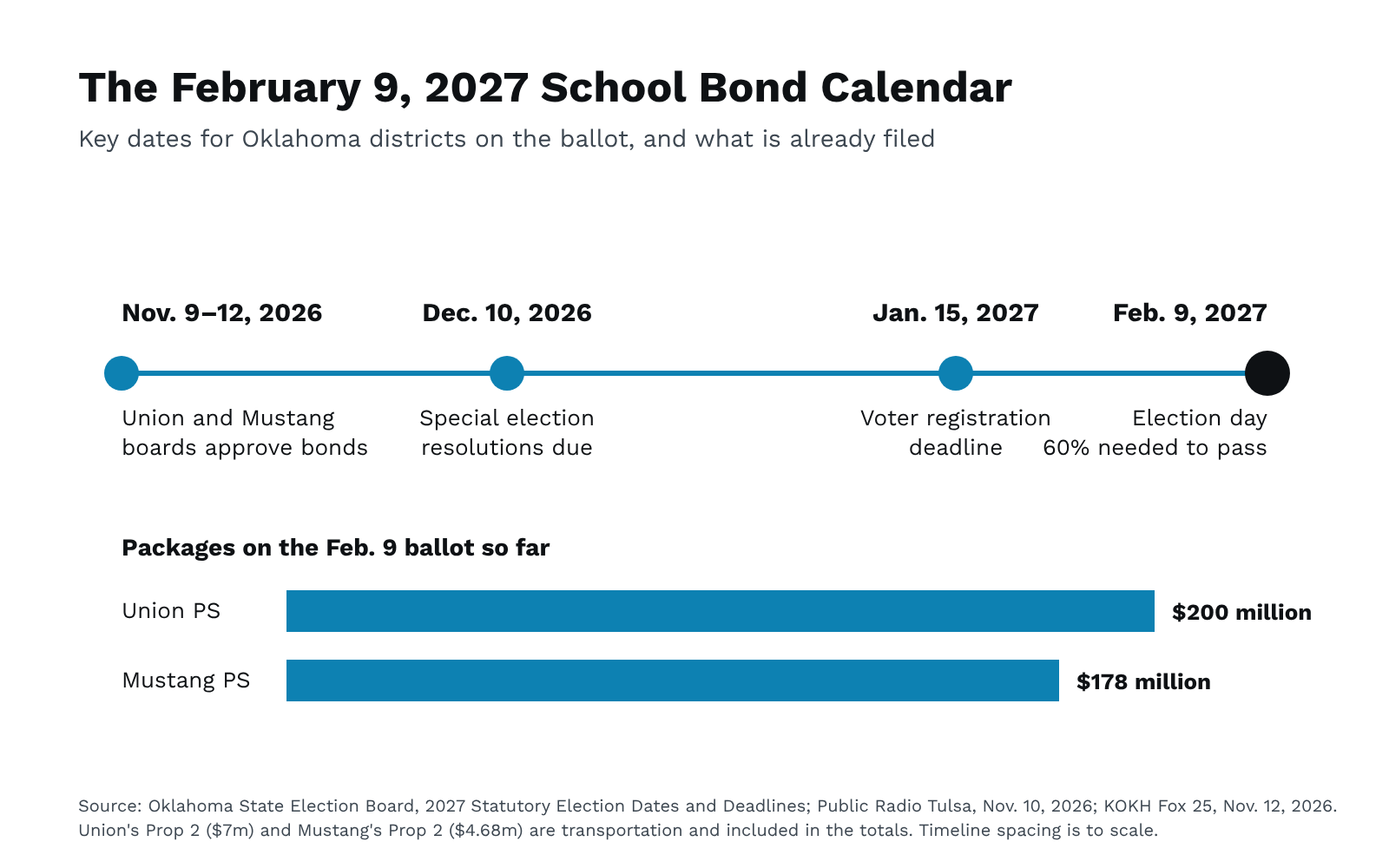
Look at the gap between those dates. A resolution in December, a vote in February, then design, then bidding. By the time a contractor prices the finished drawings, the market may have moved a long way from the number on the ballot.
Right now, it's moving. Associated Builders and Contractors reported on November 13 that construction materials prices are 11.5% higher than a year ago, even after a flat October. We broke down where that's coming from in Steel Is Up 27%. Here's How to Protect Your 2027 Budget. If your bond estimate was built on last year's costs per square foot, it may already be light.
HVAC deserves a special mention. It's a big piece of both Union's and Mustang's packages, and mechanical and electrical equipment are some of the items most exposed to metal prices and long lead times. A bond that funds a district's HVAC needs is only as good as the price and delivery date on that equipment.
How It Usually Goes Wrong
Nobody sets out to put a bad number on a ballot. The way it's always been done makes it easy.
A district builds its list with input from staff, parents, and a facilities assessment. An architect puts rough costs on it. The board adds a cushion and calls the election. The builder doesn't see the project until the drawings are done and it's out for bid.
When those bids come in over the bond amount, the choices are all bad. Cut scope your community voted for. Pull from another project on the list. Or delay and hope prices come back down. None of those help the next time you ask voters for 60%.
Architects are designing without current pricing from the trades who will actually build it, and boards are making decisions with the information they have. The fix is getting better information into the room sooner.
What This Means for Your Project
You can't control the election calendar or the steel market. You can control how solid your numbers are before they go on the ballot.
1. Get the bond list priced before the resolution
Before your board votes on the dollar amount, have a builder put conceptual budgets on each project. Base them on current pricing in your area, including the trades and equipment that are moving the most. It's the same thinking behind calling a builder before the design is locked.
2. Carry escalation all the way to bid day
Ask what your project will cost on the day it's actually bid. If design takes a year after the vote, your budget needs an honest escalation number for that year. Put it in the bond amount instead of hoping prices drop.
3. Build a schedule your community can count on
Voters remember the opening date you announce. Lay out the real timeline from vote to design to bid to move-in, including long-lead equipment like HVAC units and switchgear. If a project can't open by a certain school year, say so before the election.
4. Bring your builder and trades in during design
Once the bond passes, keep pricing alongside design so your architect gets cost feedback while there's still time to adjust. Having the mechanical and electrical trades at the table early is how you protect the big-ticket items. You can see how we set that up on our educational facility construction page and in our methodology.
Common Questions About School Bond Planning
When is the next school bond election in Oklahoma?
The State Election Board lists February 9, 2027 for school board primaries and special elections, with resolutions for special elections due December 10, 2026. The next date after that is April 6, 2027.
What percentage does a school bond need to pass in Oklahoma?
60% of the vote. Newcastle's $15 million bond fell short of that threshold in August 2026.
How can a district make sure its bond amount covers the projects?
Get each project priced by a builder before the board sets the amount, carry escalation through the expected bid date, and keep the builder and trades involved during design so costs are checked as the drawings develop.
A bond election is a promise to your community. The districts that keep that promise are the ones that knew what the buildings cost before they asked.
Construction is already hard. We don't need to make it any harder.
Planning a project in Oklahoma? Let's talk before the design is locked. Talk to Our Team
We Dare to Build Better.
Sources: Oklahoma State Election Board, 2027 Statutory Election Dates and Deadlines, updated August 14, 2026; Public Radio Tulsa, November 10, 2026; KOKH Fox 25, November 12, 2026; Tulsa Flyer, November 17, 2026; KGOU, August 26, 2026; Muskogee Public Schools release via MuskogeePolitico, August 25, 2026; Associated Builders and Contractors, news release, November 13, 2026.