
Construction material costs jumped again this fall, and the bill hasn't fully reached Oklahoma owners yet.
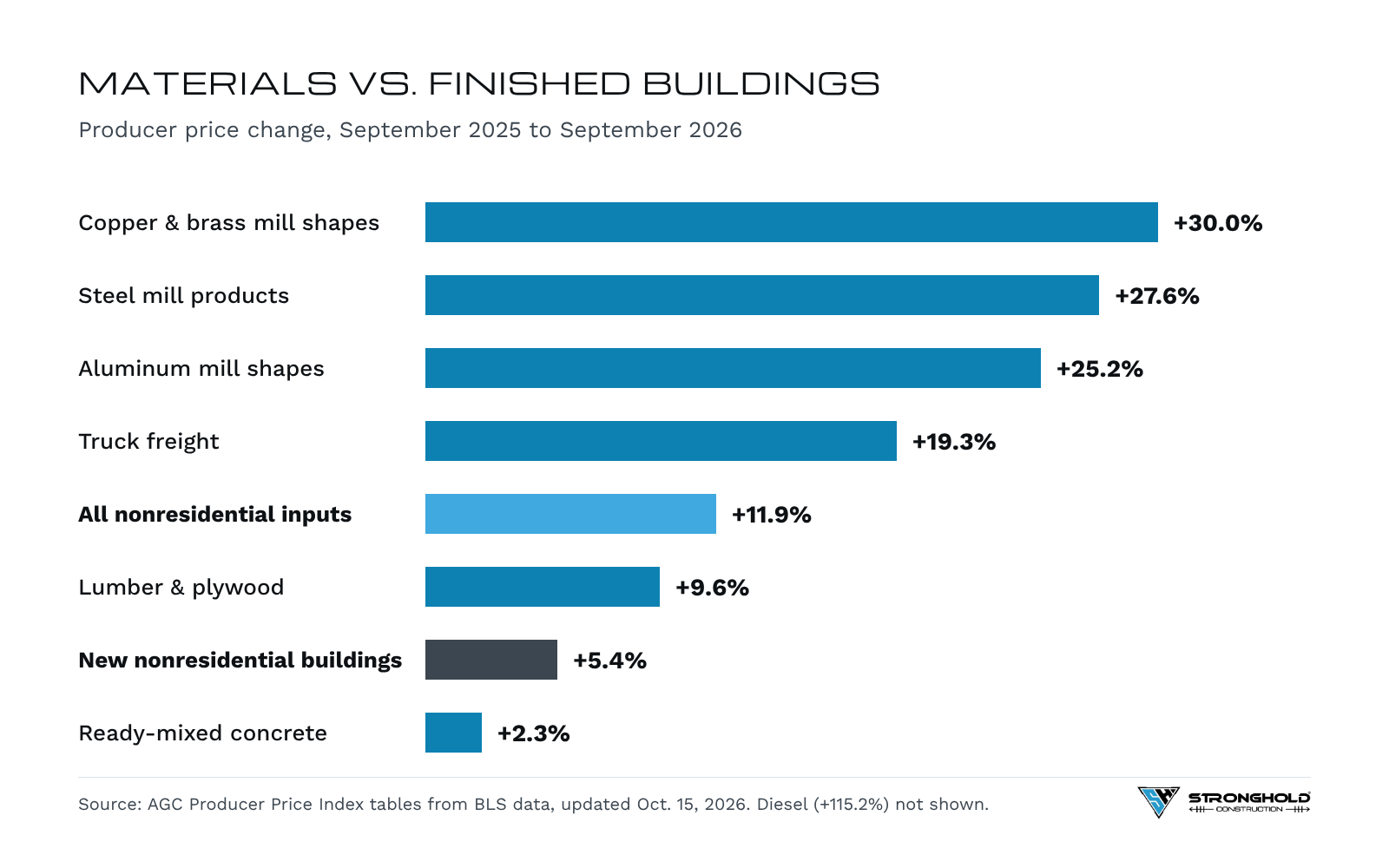
On October 15, the Associated General Contractors of America reported that the prices contractors pay for nonresidential construction inputs rose 11.9% from September 2025 to September 2026. That's the biggest jump in four years. Steel, copper, aluminum, and diesel led the way, and AGC says the increases are now spreading to freight and other goods.
If you're an Oklahoma owner planning a school addition, a clinic, a church expansion, or a tribal facility for 2027, this matters more than the headline suggests. Prices for finished buildings haven't caught up to what contractors are paying for materials. That gap won't stay open forever, and when it closes, it closes on someone's next bid.
Key Takeaways
Inputs for nonresidential construction cost 11.9% more in September than a year earlier, with steel up 27.6% and copper up 30%.
Prices for new nonresidential buildings rose only 5.4% over the same year, so contractors have been absorbing a lot of the increase.
Steel suppliers are reporting order books full into spring 2027, which makes long-lead items a schedule risk as well as a cost risk.
Owners who get pricing feedback during design and buy the volatile packages early have the most control over what happens next.
Construction Material Costs: What Went Up, and by How Much
The biggest moves are in the materials that go into almost every building we put up in Oklahoma. According to AGC's September 2026 producer price tables, compiled from Bureau of Labor Statistics data, steel mill products rose 27.6% year over year. Aluminum mill shapes rose 25.2%. Copper and brass mill shapes rose 30%. Diesel more than doubled, up 115.2%, and truck freight was up 19.3%.
Not everything spiked. Ready-mixed concrete was up 2.3% and gypsum products were essentially flat. Lumber and plywood rose 9.6%.
AGC points to two drivers: tariffs on metals and higher fuel costs tied to the conflict with Iran. A separate analysis from Associated Builders and Contractors, reported by Construction Dive on October 16, put the annual increase for construction inputs at 11.2% and called it the largest in nearly four years. The two groups measure it a little differently, and both land in the same place.
I come from an electrical family, so the copper number is the one that jumps out at me. Copper is in every foot of wire, every piece of switchgear, and every transformer on your project. When it moves 30% in a year, your electrical package moves with it.
Why Your Bids Haven't Felt It Yet
Here's the part most owners haven't heard. The same AGC tables show the price index for new nonresidential building construction rose 5.4% over that year. Schools were up 5.2%. Healthcare buildings were up 5.2%. Inputs were up 11.9%.
That difference is coming out of contractor and trade margins. Construction Dive reported that most of the increases are being absorbed by contractors, and AGC said soft demand is making it hard to raise bid prices.
The demand picture backs that up. ABC's October survey, covered by Construction Dive on November 10, showed backlog for contractors outside the data center buildout falling from 8.3 months to 7.6 months in a single month. Contractors working on data centers sat at 11.5 months. About 1 in 4 contractors still expect their margins to shrink over the next six months.
So right now you have hungry builders eating cost increases to win work. That can feel like good news if you're buying. The risk is that it shows up later as thin bids, change order fights, and trades that can't afford to finish the job the way they priced it. We wrote about what that pattern does to a project in The Moment I Realized Our Owner Change Order Numbers Weren't Normal.
Projects Are Already Getting Pushed
Rising costs are already changing owners' plans. In AGC's survey with NCCER, released in September, 55% of contractors said they'd had a project canceled, postponed, or scaled back in the previous six months. A third of them pointed to rising costs.
Schedule is the other half of the problem. AGC reports that steel supplier order books are full through spring 2027, and Construction Dive reported that some firms have been told they'll get only a fraction of the steel beams they ordered. If your project needs structural steel, switchgear, or rooftop equipment, the lead time can drive your opening date as much as the budget does.
In Oklahoma, that pressure stacks on top of everything else already in the pipeline: the growth we covered in our 2026 market outlook, public infrastructure work, and the data center projects already approved and pulling from the same trades and suppliers. We covered the labor side of that in Oklahoma's Data Center Boom Is Coming for Your Electrician.
What This Means for Your Project
You can't control tariffs or diesel. You can control when you find out what your building costs and when you buy the parts that are moving the most.
1. Get real pricing while the design can still change
The worst time to learn steel went up 27% is bid day, after months of design. Bring a builder in early so conceptual budgets run alongside design and your architect gets cost feedback while there's still time to adjust. If you're not sure who to call first, start with Should I Call an Architect or a GC First? and see how we set that up in our methodology.
2. Buy the volatile packages early
Structural steel, electrical gear, and major mechanical equipment are the items most exposed right now. Early release packages let you lock pricing and get in line with suppliers before the drawings are 100% done. That only works when your builder and trades are already at the table during design.
3. Carry an honest escalation number
If your budget was built last year, it probably doesn't reflect where metals are today. Ask your team to update it with current pricing and carry a real escalation allowance for anything you can't buy yet. Talk through how price changes will be handled in your contract before you sign it, so nobody is surprised later.
4. Get priced alternates on the big systems
Sometimes the answer is a different system. Concrete held steady while steel and aluminum jumped, and that can change which structure, framing, or envelope makes sense. Ask for alternates on the structure, framing, and envelope so you can make the call with numbers in front of you.
Common Questions About Construction Material Costs in 2027
How much have construction material costs gone up?
AGC reports that inputs for nonresidential construction cost 11.9% more in September 2026 than a year earlier. Steel mill products rose 27.6%, copper rose 30%, and aluminum rose 25.2%.
Will construction costs go down in 2027?
Nobody can promise that. AGC ties the increases to metal tariffs and fuel costs, and steel suppliers report order books full through spring 2027. Build your budget on current pricing and carry an escalation allowance for anything you can't buy yet.
How can an Oklahoma owner protect a project budget from rising material prices?
Get pricing while the design can still change, release steel and electrical gear early, carry an honest escalation number, and ask for priced alternates on the big systems. All four work best with a builder at the table before the design is locked, which is how Stronghold Construction works with owners across Oklahoma.
Material prices will move again, up or down, and nobody can tell you exactly when. What you can do is find out early, decide with real numbers, and give your trades a fair price they can actually build to. That works whether you're building a school, a clinic, or a tribal facility.
Construction is already hard. We don't need to make it any harder.
Planning a project in Oklahoma? Let's talk before the design is locked. Talk to Our Team
We Dare to Build Better.
Sources: Associated General Contractors of America, news release, October 15, 2026; AGC, Producer Price Index tables (BLS data), updated October 15, 2026; AGC and NCCER, survey release, September 10, 2026; Construction Dive, October 16, 2026; Construction Dive, November 10, 2026.