
If your drawings started under the old code, find out before you submit for permit.
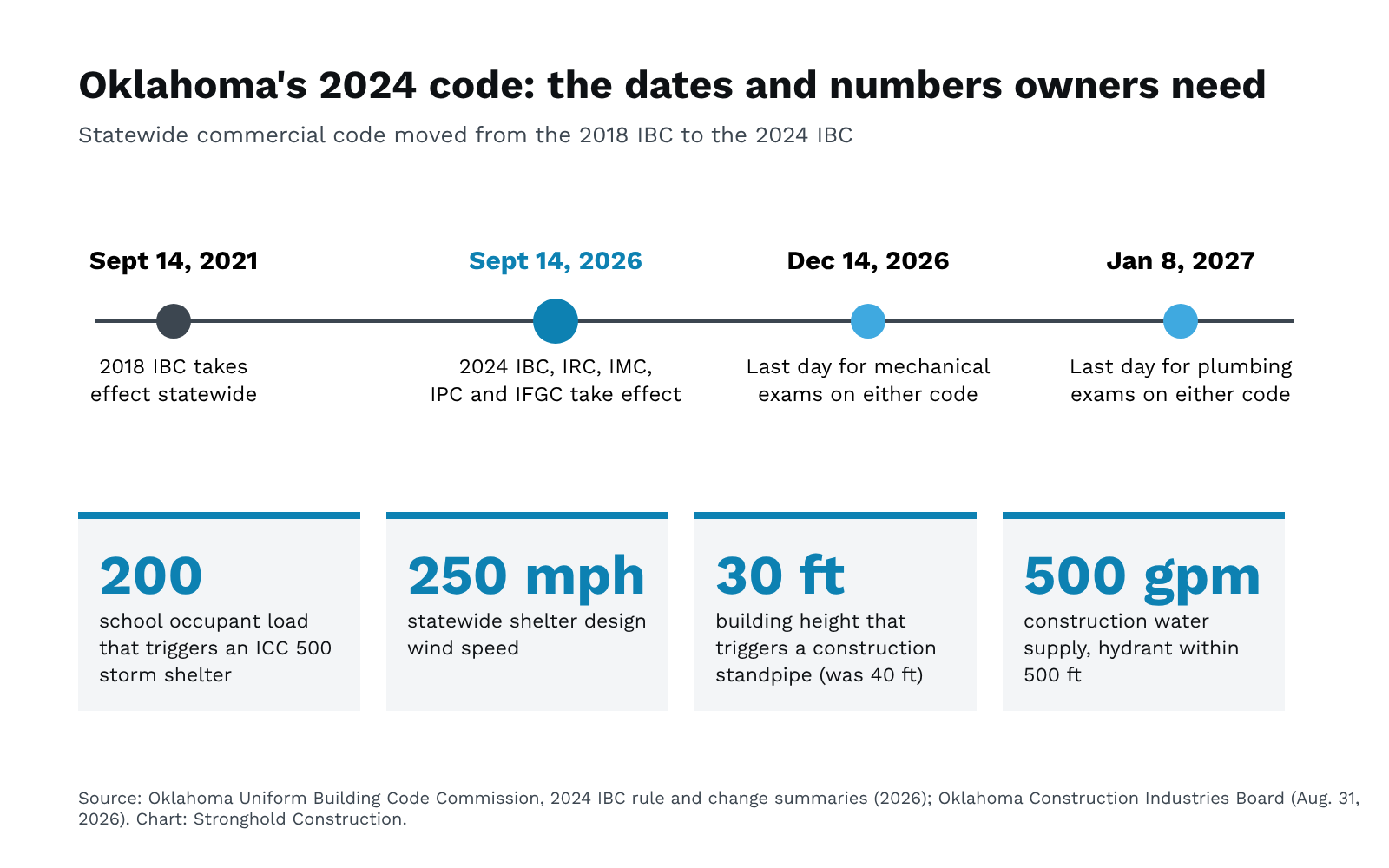
On September 14, 2026, Oklahoma moved to the 2024 International Building Code as the statewide minimum for commercial construction. The Construction Industries Board says the Oklahoma Uniform Building Code Commission adopted the 2024 editions of the building, residential, mechanical, plumbing and fuel gas codes, with Oklahoma amendments, all on the same date.
That's a six-year jump. The state had been on the 2018 IBC, which took effect here in September 2021. And the trades are still catching up. Licensing exams for mechanical trades can be taken on either code until December 14, and plumbing exams until January 8, 2027. After that, the new code is the only one tested.
If you're an owner with a school, clinic, church or commercial building somewhere between a sketch and a permit, this one is worth an hour of your time.
Key Takeaways
Oklahoma's statewide commercial building code moved from the 2018 IBC to the 2024 IBC on September 14, 2026, along with the 2024 mechanical, plumbing, fuel gas and residential codes.
The adopting rule doesn't lay out a grandfather window for projects already in design, so plans that started under the 2018 code should be checked before they go in for permit.
Schools over the 200-occupant threshold still need ICC 500 storm shelters, and the 2024 existing building code applies the same idea to additions and changes of use.
Several changes hit the jobsite itself, including construction standpipes at 30 feet instead of 40 and a 500 gpm water supply during construction.
What Changed, and What Didn't
Start with what stays the same. Oklahoma still writes its own amendments on top of the model code, and the state code is still the floor. Under the OUBCC rule, cities can only amend it the way state law and the commission's rules allow, and they can choose to adopt appendices that the state left out.
What changed is the base those amendments sit on. The OUBCC's change summary walks through the Oklahoma modifications section by section. A few that matter for owners:
Retaining walls over 4 feet now need plans sealed by an Oklahoma-licensed engineer.
Roof design for rain loads uses NOAA 15-minute rainfall rates.
A new roof can't be laid over existing asphalt shingles.
Parks and campgrounds, public or private, need adult changing stations.
Water dispensers can replace up to half of the required drinking fountains in some occupancies.
None of that is dramatic on its own. The problem is timing. A civil sheet with a 5-foot retaining wall, a roof re-cover detail, or a fixture count done under the old rules is a quick fix in design. It's a resubmittal, a redesign fee and a few weeks of lost time if the plan reviewer catches it first.
The rule doesn't spell out a transition window for drawings that were already underway. So the safe question to ask your architect is simple: which code edition are these drawings checked against, today?
Schools: The Storm Shelter Rule Reaches Further
For K-12 owners, the biggest item is section 423. Oklahoma's version requires an ICC 500 storm shelter for Group E (school) buildings with an occupant load over 200, according to the 2024 change summary. Oklahoma had already raised the model code's 50-occupant trigger to 200 under the 2018 code, per a 2023 architect's letter to Westville Public Schools. So the threshold isn't new.
What's worth your attention is how the shelter rules connect to renovation work. Under the 2024 existing building code summary, an addition to a school with an occupant load of 200 or more needs a shelter. Shelter capacity is based on all the students and staff who are there on a regular basis, and the district has to put that number on letterhead. A building that changes use to a school also has to meet the shelter section.
Shelters are designed for a 250 mph wind speed statewide. That's thick walls, rated doors and hardware, and a structural system that doesn't leave much room for late changes. If your February bond list includes a classroom wing or a building you're converting, the shelter needs to be in the budget before the number goes to voters.
Critical emergency facilities, including 911 centers, emergency operations centers, and fire, police and EMS stations, also need an ICC 500 shelter under section 423.3.
The Jobsite Changes Too
Some of the most practical changes don't touch the finished building at all. They change how it gets built.
Construction standpipes are now required once a building reaches 30 feet, down from 40, under section 3311.1. The construction water supply has to deliver 500 gallons per minute, with a hydrant within 500 feet of combustible materials on site. The existing building code carries the same standpipe change, with some relief for rural and small-community projects.
A building under construction is at its most vulnerable, with open framing, stacked materials and no finished fire protection. I'm glad to see this one.
For an owner, though, it's a cost and a schedule item. A three-story building that never needed a construction standpipe may need one now. If the site doesn't have a hydrant close enough, someone has to figure that out early, because the fire marshal will.
Energy Code: Still an Open Question
One area isn't settled. The OUBCC lists the commercial energy code as still under review. If your project has energy targets, or financing tied to them, ask your design team which energy standard they're using and plan to confirm it again before permit.
What This Means for Your Project
1. Ask which code your drawings are checked against
If design started before September 14, ask your architect to confirm in writing which edition the drawings follow. A one-page code review now is a lot cheaper than a resubmittal later. This is the kind of thing that comes up when your builder is at the table early instead of showing up at bid day.
2. Price the code changes as the design is drawn
Shelters, standpipes, sealed retaining walls and roof changes all carry cost. Your builder should be pricing the design as it develops, so those items show up in the budget at schematic design instead of as change orders.
3. Schools: put the shelter in the bond number
If you're planning an addition or conversion, get the shelter scope and cost into the plan before your board sets the ballot amount. Our school construction team works through this with districts every year.
4. Plan the site for construction fire protection
Confirm hydrant distance and water supply during site planning. If the building will pass 30 feet, carry a construction standpipe in the budget and the schedule.
5. Check your trades are current
Your mechanical and plumbing partners are moving to the new code through exam windows that close December 14 and January 8. Ask your builder how its trade partners are getting ready.
A new code isn't a reason to panic. Most of these changes make buildings safer, and some give owners more flexibility. They just need to be caught while they're still lines on paper.
Construction is already hard. We don't need to make it any harder.
Planning a project in Oklahoma? Let's talk before the design is locked.
We Dare to Build Better.
Sources: Oklahoma Uniform Building Code Commission, 2024 IBC Permanent Rule (effective Sept. 14, 2026); OUBCC, 2024 IBC Code Change Summary (2026); OUBCC, 2024 IEBC Code Change Summary (2026); OUBCC homepage (Sept. 2026); Oklahoma Construction Industries Board, "2026 Updated Building Code" (Aug. 31, 2026); Architect's storm shelter letter to Westville Public Schools (Apr. 24, 2023).