
Oklahoma doesn't license general contractors, so the vetting is on you. Here's how to do it before you sign anything.
If you've ever hired a contractor and felt like you were guessing, you're not alone. Commercial construction in Oklahoma City moves fast, budgets are tight, and the wrong general contractor can turn a simple job into a slow-motion dispute full of change orders, schedule slips and finger-pointing.
Here's what surprises a lot of owners: Oklahoma doesn't require general contractors to hold a state license. That covers commercial buildings, roads, utilities and most of what gets built in between. Any company can put "commercial general contractor" on a truck and start bidding.
With Oklahoma heading into one of the busiest building stretches in its history, more firms are chasing more work, and a lot of them are stretched thin. Whether you're a developer, school district, tribal nation, city, healthcare group or tenant, here's how to find a GC you can trust and check them before you sign.
Key Takeaways
Oklahoma doesn't require a state license to work as a general contractor, so you have to do the vetting yourself.
Your best shortlist comes from architects, engineers and facility directors who've watched contractors work under pressure.
A reputable GC controls scope, schedule and risk, and you can see the proof in how they handle preconstruction.
Meet the project manager and superintendent who'll run your job, and call an owner, an architect and a subcontractor they've worked with.
What Makes a Commercial General Contractor Reputable?
A reputable commercial GC does three things well, on every job:
They control scope, so the project doesn't bleed money through gaps and assumptions.
They control the schedule, so "two weeks" doesn't turn into "two months."
They control risk, including safety, insurance, compliance, subcontractor management and documentation.
When a commercial project goes sideways, it's usually because the GC lost control of one of those three.
Terms You'll Hear
These will come up in every GC interview:
Preconstruction is the planning phase before anyone builds: budgeting, scope gap checks, schedule planning, lining up subcontractors and ordering long-lead items.
A guaranteed maximum price (GMP) is a price cap built on stated assumptions and allowances. A GMP is only as good as the scope definition behind it.
With construction manager at risk (CMAR), the builder joins during design and commits to a GMP before construction starts.
With CM/GC, the builder also joins early, but the construction price is negotiated once the design is far enough along. If the number doesn't work, you aren't locked in.
Buyout is when the GC signs subcontracts and purchase orders after the project is awarded.
Long-lead items are materials and equipment with long order times, like switchgear, rooftop units and generators. They often drive the schedule more than field labor does, and their prices can move fast.
Where Can I Find a Reputable Commercial General Contractor in Oklahoma City?
1. Start With People Who've Seen GCs Under Pressure
The fastest way to a real shortlist is to ask the people who watch contractors work every day. Architects, civil engineers, owner's reps, commercial real estate brokers and facility directors at schools, clinics and city departments all have opinions, and most of them will share if you ask.
Ask them two questions:
Who would you trust with your own money on a project like mine?
Who would you never hire again, and why?
You'll start hearing the same names come up, good and bad. That pattern is worth more than any ranking or award.
2. See Who Public Owners Have Picked
School boards and city councils approve their construction manager selections in public meetings, and the agendas and minutes are usually posted online. If the same GC keeps getting picked for CMAR or CM/GC work by districts and cities near you, those owners have already checked that firm's qualifications.
3. Drive Around
When you pass a commercial jobsite that's organized, clean and safe, write down the GC's name from the sign. A jobsite is a live preview of how a contractor will run your project.
4. Use Google, but Filter Like a Skeptic
Google is fine for building a list, but don't let it make the call. Search "commercial general contractor Oklahoma City," "construction manager Oklahoma City" or "design-build contractor Oklahoma City," then filter hard. Is the portfolio commercial, or mostly residential and light metal buildings? Do the project pages list the scope, schedule and delivery method? Is there any sign of a real preconstruction process behind the lines about integrity and excellence?
How to Vet a Commercial General Contractor
Once you have three to five names, these are the things that predict how a GC will perform on your job.
Relevant Experience
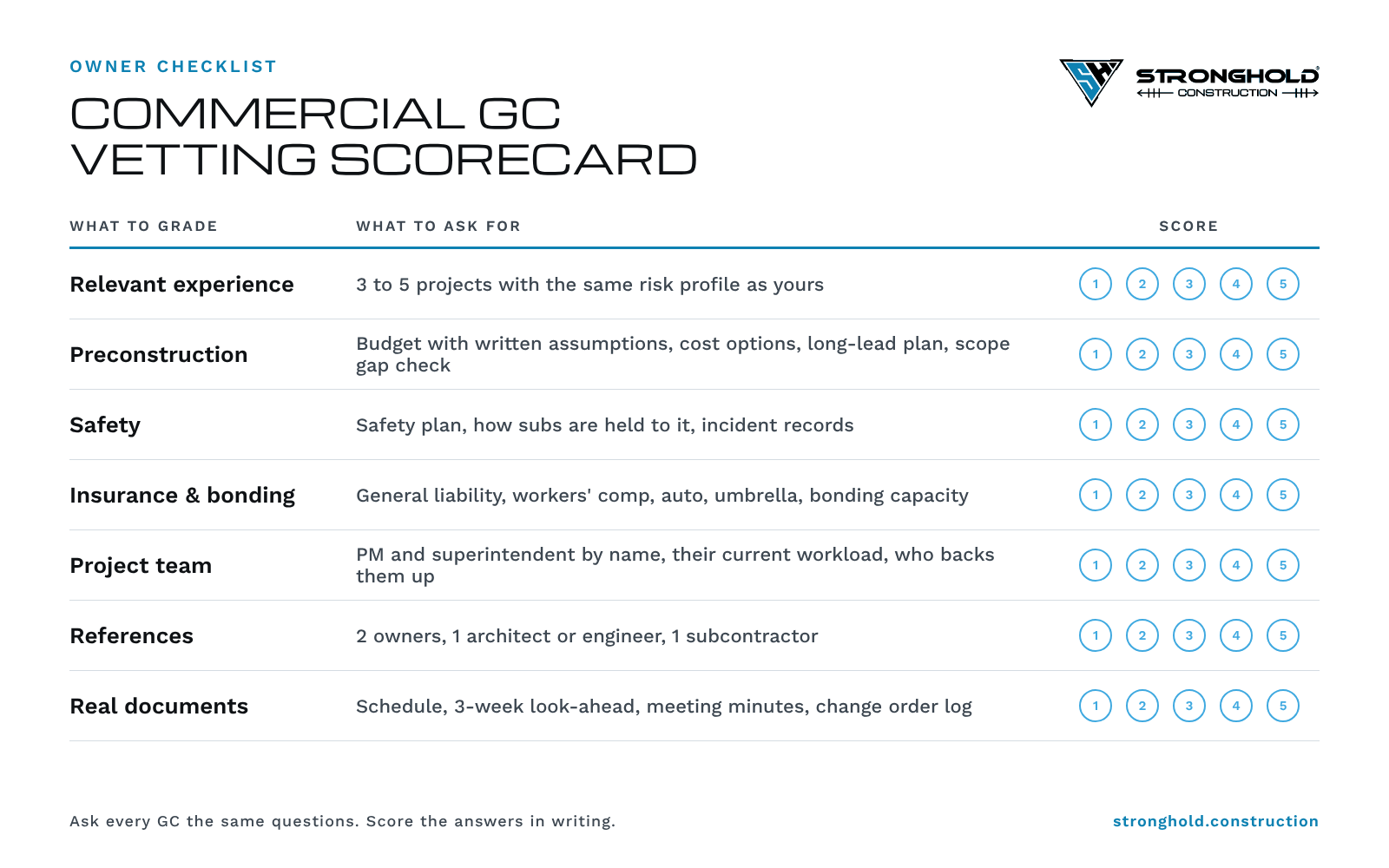
Ask for three to five projects that match your situation: an occupied renovation or a vacant building, healthcare requirements, tribal or public compliance, MEP-heavy work or light tenant finish, tight phasing. A contractor can be good and still be wrong for your project.
Preconstruction
Most budget problems start before anyone breaks ground. A project gets designed for months without a builder at the table, then goes out to bid and comes back over budget. We walked through that pattern in Should I Call an Architect or a GC First?
A GC worth hiring should be able to show you:
A conceptual budget with the assumptions written down
Cost options with the trade-offs explained
A plan for long-lead equipment
Which trades they plan to bring in, and why
A check for scope gaps between the drawings and the budget
Ask which delivery method they'd recommend, and why. A good contractor will tell you what fits your budget, schedule and risk instead of selling every owner the same approach. Our post on the low-bid model covers the alternatives Oklahoma owners use. If preconstruction feels loose, construction will feel worse.
Safety, Insurance and Bonding
Ask how they plan for safety, hold their subcontractors to it, and document incidents. A contractor who's casual about safety is usually casual about everything. Then confirm general liability, workers' comp and auto coverage, an umbrella policy if your project needs one, and whether they can bond a project your size.
Who Will Actually Run Your Job
Ask for the names of the project manager and superintendent, what they're running right now, how many projects they're carrying, and who backs them up when something goes sideways. With data centers pulling electricians across the state, ask how they plan to staff the trades on your job too.
References Beyond the Highlight Reel
Ask for two owners, one architect or engineer, and one subcontractor. The subcontractor reference tells you the most. If the trades don't like working for a GC, you'll feel it in your schedule and your quality.
Ask to see real documents too: a schedule, a three-week look-ahead, meeting minutes and a change order log. Redacted is fine. A contractor who runs a clean job won't mind showing you how they run it.
Put all of this on one scorecard and grade every GC the same way, in writing. It keeps the decision about proof instead of who gave the best pitch.
Bigger Firm or Smaller Firm?
Size cuts both ways. A larger GC usually has more staff depth, a bigger subcontractor network and more buying power on long-lead equipment, but there are more layers between you and a decision, and a smaller project may not get their senior people.
A smaller GC often puts senior leadership on your job, makes decisions faster and is more flexible on delivery method. Make sure they aren't stretched too thin, can carry the cash flow, and have subcontractor coverage in your sector. Pick the team that fits your project and can show you how they run one.
Red Flags to Watch For
One bid comes in way below the others. Assume something is missing from the scope until they prove otherwise.
They get defensive when you ask about their assumptions. Good contractors explain them plainly.
Nobody brings up long-lead items during preconstruction. If they aren't planning procurement early, they're guessing at the schedule.
They can't explain how they handle change orders. Some changes are unavoidable, like added scope or a condition hidden behind a wall, so ask how they price and document them. Our post on owner change orders covers what tracking our own numbers taught us.
What This Means for Your Project
1. Bring a GC in Before the Design Is Locked
Start interviewing contractors while the design is still moving. The earlier a builder is at the table, the more of your budget you can still change. Our methodology page lays out how we handle that early phase.
2. Ask How They'll Price the Design as It's Drawn
You want budget updates that track the design as it develops, so your architect gets cost feedback while there's still time to adjust. If the first real number shows up on bid day, it's too late to do much about it.
3. Ask How They Pick Their Trades
The subcontractors build your project. Ask whether the GC brings electrical, mechanical and concrete partners in during design, or just takes the lowest number at buyout.
4. Ask What You'll Hear Every Week
A weekly owner, architect and contractor meeting, a written update, progress photos and access to daily reports should all be on the table. If the answer is "we'll keep you posted," keep asking.
5. Ask How a Problem Reaches You
Every project has problems. A good GC brings them to you with a few options and a recommendation, and a lot of the time they're handled before you ever hear about them.
Choosing a commercial general contractor in Oklahoma City comes down to proof. The best outcome is a contractor who tells you the truth early, documents everything and runs a jobsite that looks like it has leadership.
Construction is already hard. We don't need to make it any harder.
Want a second set of eyes before you sign with anyone? Let's talk before the design is locked. Talk to Our Team
We Dare to Build Better.
Sources: Oklahoma.gov, "Building and General Construction Contractors," accessed November 2026.